PolyAnno: Homepages, Queues, and Others

This is part of my series of posts about the PolyAnno project – more here Having at least partially separated out the core functionality of the complete generic annotation package into different back and front end libraries, I then finally needed to complete all the remaining features of a website specifically for the University of … Continue reading PolyAnno: Homepages, Queues, and Others

PolyAnno: Further Product Development 2

This is part of my series of posts about the PolyAnno project – more here Separating PolyAnno from "The Polyglot Project" I then intended to release the PolyAnno package separately from the project specifically for the University of Edinburgh. I felt that it was important to create reusable code specifically for the providing the combination … Continue reading PolyAnno: Further Product Development 2

PolyAnno: Initial Ideas and Research 1

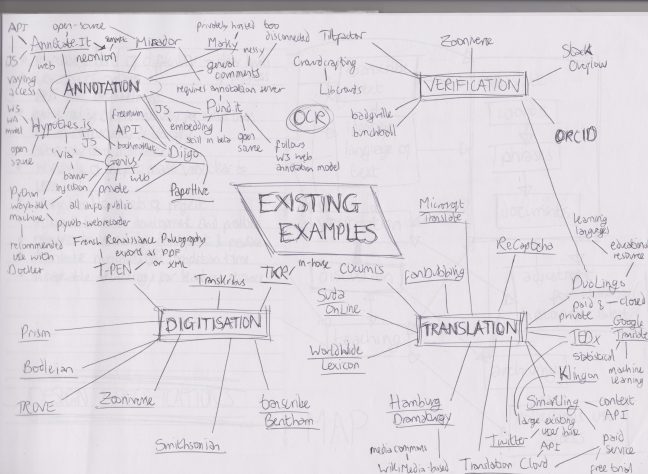
This is part of my series of posts about the PolyAnno project - more here Dividing Up the Problem My first tactic was to split the problem into several sections: Digitisation Transcription Translation Verification Gamification I then tried to investigate existing examples of products and projects within these fields to analyse and I quickly realised … Continue reading PolyAnno: Initial Ideas and Research 1

PolyAnno: DragonDrop UI Design

This is part of my series of posts about the PolyAnno project – more here Basics To make development easier, I separated the development of the front-end Javascript and CSS package to allow me to generate, adjust the size of, drag and drop, adjust responsively to screen size, minimise, and then delete, boxes across the … Continue reading PolyAnno: DragonDrop UI Design

Science, Engineering and Maths Themed Playlists

So I created several Science Technology Engineering and Maths (STEM) themed playlists on Spotify following on from the (relative) success of the materials and elements playlists and of course, in the process I went looking for others around the internet have found a few that other people have made... Here I present my findings: My … Continue reading Science, Engineering and Maths Themed Playlists

PolyAnno: Polyanno Storage

This is part of my series of posts about the PolyAnno project – more here Basics Eventually I decided it would be easier to separate out development of the longer term storage i.e. the Node/Express/MongoDB/Mongoose framework such that it can be installed separately and understood more simply in isolation. The Github repo can currently be … Continue reading PolyAnno: Polyanno Storage

PolyAnno: Transcription

This is part of my series of posts about the PolyAnno project - more here Getting Content So when I started the project I definitely thought the most difficult of the annotations to handle would be the translations and so my immediate focus regarding with the transcriptions was more to just get them as quickly … Continue reading PolyAnno: Transcription

Polyanno: Basic API Design

This is part of my series of posts about the PolyAnno project - more here Storage and API Setup To store the annotations I decided to use MongoDB as a classic NoSQL, non-relational database to store the JSON-LD files because of its support for handling JSONs. I decided for simplicity to use Mongoose as a … Continue reading Polyanno: Basic API Design

PolyAnno: Image UI Design

This is part of my series of posts about the PolyAnno project - more here The Images So the first consideration I had with the transcription design was not the texts but the images themselves. Firstly, images taken as digital copies of collections like Edinburgh's are taken at incredibly high resolutions - every possible pixel … Continue reading PolyAnno: Image UI Design

A Complete Beginner’s Guide to Hacking: Data Design

This post is part of the series A Complete Beginner's Guide To Hacking So the main website languages define files that are sent off to be interpreted "client side" or rather to be interpreted by the browser that the client or user trying to view the page has. Client side languages are really good for … Continue reading A Complete Beginner’s Guide to Hacking: Data Design